Why High‑Performance Digitizers Matter
High‑resolution, high‑speed digitizers enable RADAR systems to operate with greater flexibility and precision. Wide analog bandwidth allows designers to select optimal IF bandwidths or implement direct RF sampling without additional analog front‑end complexity. High spurious‑free dynamic range (SFDR) is essential for resolving weak target echoes in the presence of strong nearby signals or self‑interference.
Equally important is the ability to process data close to the point of acquisition. Modern RADAR systems increasingly rely on real‑time digital signal processing for functions such as digital down‑conversion, filtering, pulse detection, and data reduction. Digitizers with open FPGA architectures allow these operations to be implemented directly on the acquisition hardware, reducing data volumes and latency while enabling application‑specific processing pipelines.
Multi‑Channel Synchronization and Scalability
Many RADAR applications require scaling from a few channels to tens or hundreds of synchronized inputs. This is common in large antenna arrays, MIMO RADAR, and distributed sensing systems. In such setups, precise trigger distribution and clock alignment are essential to preserve phase coherence across all channels.
Advanced data acquisition platforms address this by supporting shared reference clocks, deterministic trigger propagation, and hardware‑level synchronization mechanisms. These features enable coherent sampling across large systems without the timing uncertainty introduced by external fan‑out or software‑based synchronization methods. As a result, system designers can scale channel counts while maintaining the timing accuracy required for high‑resolution RADAR measurements.
The Importance of Triggering and Trigger Distribution
Triggering is a fundamental aspect of multi-channel data acquisition systems, ensuring that data capture begins precisely when required by the application. A trigger signal initiates the data acquisition process, synchronizing the start of data collection across all channels. This is crucial for applications where timing accuracy is paramount, such as event detection, waveform analysis, and real-time monitoring.
Trigger distribution involves disseminating the trigger signal to all digitizers within the system. At Gigahertz sampling rates, even slight timing discrepancies can lead to data corruption. Achieving picosecond-level accuracy in trigger distribution is essential to ensure synchronized data capture across all channels. One of the key challenges includes trigger jitter, or variations in signal timing, which can severely affect overall performance. Teledyne SP Devices' digitizers include built-in timestamp functionality to effectively resolve potential trigger misalignment caused by jitter.
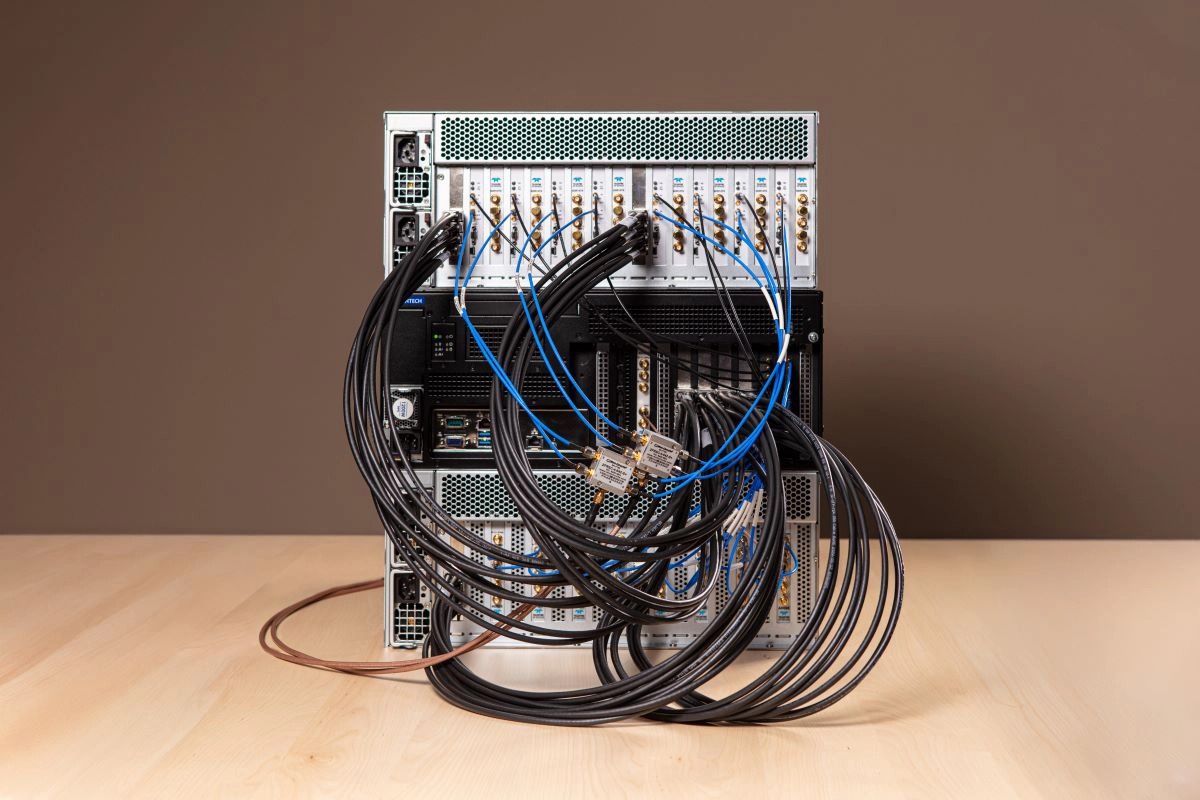
Daisy Chain Trigger Mechanism
In high-speed, multi-digitizer systems, distributing trigger signals with precision is critical to maintaining synchronization and data integrity. Traditional methods of splitting trigger signals often introduce timing mismatches and jitter, especially at gigahertz sampling rates.
To overcome these limitations, our systems implement a Daisy Chain Trigger Mechanism. In this configuration, a single primary digitizer receives the external trigger and then propagates it digitally to subsequent digitizers in a chain. This approach eliminates the fan-out problem and ensures consistent timing across all devices, achieving trigger timing precision better than 50 picoseconds even in large-scale systems.
By combining this mechanism with a shared 10 MHz reference clock distributed to all boards, we maintain a unified time base and enable synchronized data acquisition across hundreds of channels. This is essential for applications requiring ultra-precise timing, such as radar, fusion diagnostics, and high-energy physics experiments.
For a deeper dive into our synchronization and triggering technologies, visit our Multi-Channel Data Acquisition page.

